Systems analysis and AI
deep learning for network state prediction, genetic disease architecture (Speos), multi-omic network dynamics
Biological function and disease emerge from complex molecular networks shaped by genetic variation, environmental influences, and host–microbe interactions. At INET, we combine large-scale experimental network biology with artificial intelligence to uncover the principles governing these systems. Our goal is to develop predictive models that identify key network control points and enable the design of targeted molecular interventions for immune, infectious, and chronic diseases.
At INET we try to
- understand the genetics- and context-dependent operating principles of molecularnetworks, to
- enable AI-based prediction of validatable control points, for
- AI-assisted development of innovative peptide-based molecular interventions to control network function as novel therapeutics.
Our systems analysis & AI projects are:
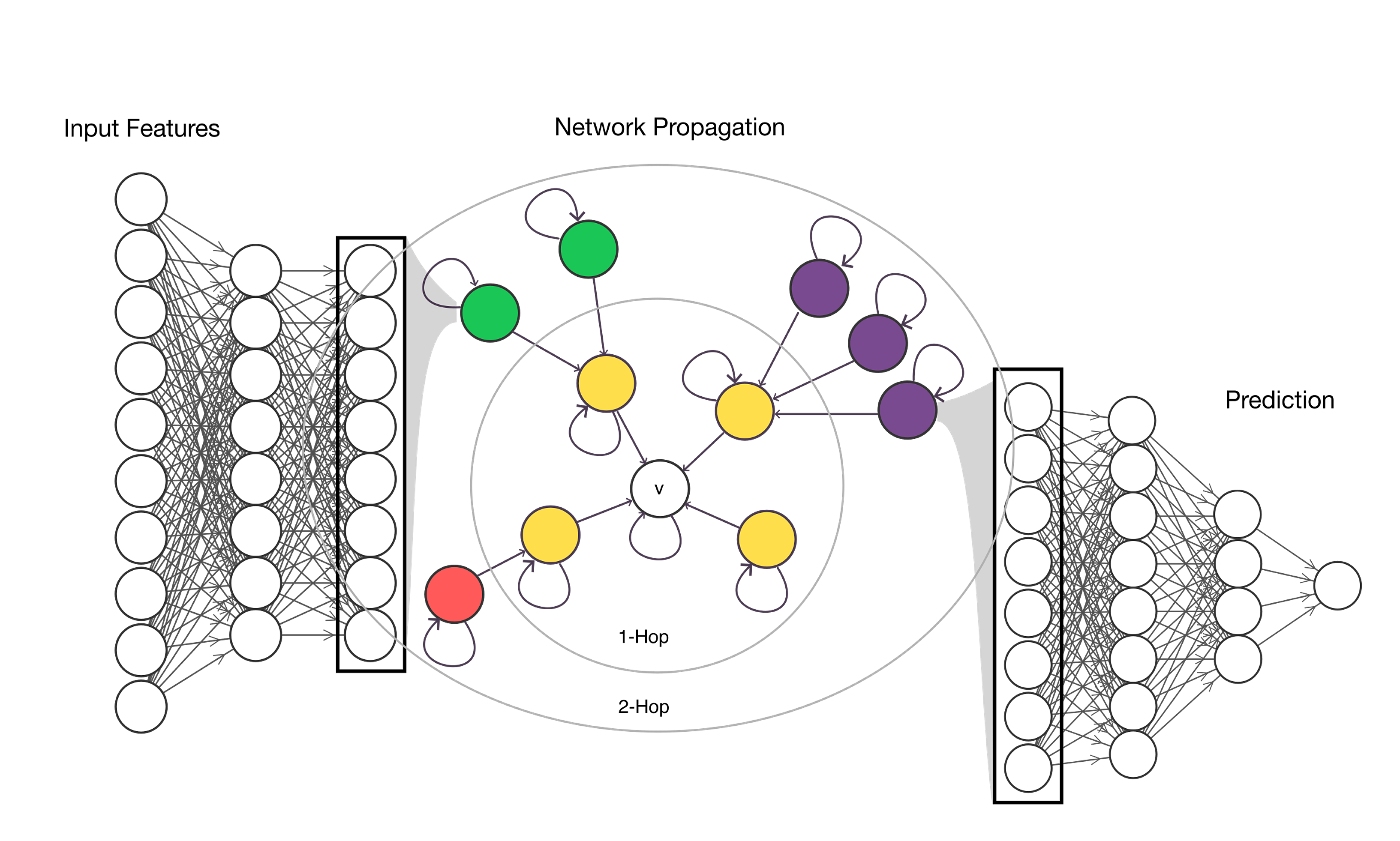
An integrated computational-experimental deep-learning framework for predicting condition-specific protein-protein interactions
The dependence of protein interactions on conditions like cell type or disease state is a question that currently cannot be answered in a satisfactory manner. Using recently generated training sets and our conceptual interactome advances we will develop a deep-learning framework for the accurate prediction of condition specific interaction networks, which we will validate experimentally. This collaborative work will enable identification of new disease mechanisms
that may lead to therapeutics and help prediction of individual disease risk for prevention.
We expect that this start-up funding can be leveraged to obtain further third-party grant funding and hence establish a long-term collaboration.
The project in cooperation with Prof. Roded Sharan, Tel Aviv Unviersity, Israel, was funded by LMU-TAU Research Cooperation Program 2024.
PhenoPred
Predicting phenotypes from genotypes is a grand challenge of biology with substantial translational implications. Using deep learning, we have already made significant progress in capturing genotype-phenotype relationships in prokaryotes. Due to the unique amount of phenotypic and molecular data for essentially all molecular modalities, S. cerevisiae is the ideal model to translate these achievements to eukaryotes. We propose to develop and validate a multi-modal deep learning framework that builds on genomic sequences, transcriptomes, environmental parameters, and regulatory and physical interaction networks to predict growth phenotypes and cell cycle properties. Powerful, AI-ready datasets, e.g. describing 200 distinct phenotypes for 4,000 deletion mutants and unpublished annotated time-lapse imaging data, enable model training and validation. For robust integration across molecular modalities, we will develop new deep learning architectures for complex multimodal data, including hierarchical attention networks to capture relationships in molecular networks. By integrating foundation models pre-trained on large datasets, we will obtain immediate insights into yeast phenotypes and establish a scalable foundation for broader applications. Beyond immediate applications in infection research and biotechnology, our model will set the stage for future expansion towards human cells using transfer learning approaches and subsequent integrative models towards predictive medicine.
The project in cooperation with Kurt Schmoller, HMGU and Philipp Münch, HZI, is funded by the Munich School of Data Science (MUDS).
Our publications in our research area systems analysis & AI: