
Democratizing 3D Brain Analysis
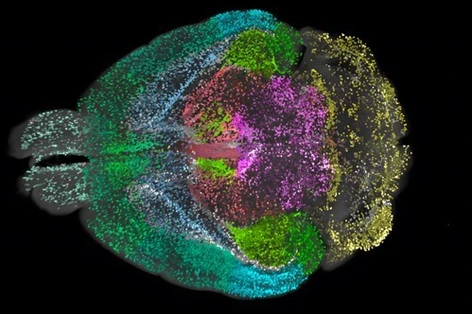
Many diseases are linked with changes in the expression of certain proteins in the brain. To study those changes, scientists examine how they change during disease progression in model organisms. Imaging entire mouse brains generates vast data sets, necessitating accurate quantification methods for its meaningful interpretation. However, identifying labeled cells within large 3D image data is challenging. While artificial intelligence (AI) holds promise for data analysis, it typically requires extensive data annotation and advanced coding skills, restricting its use to specialized labs. The research team therefore aimed to overcome these barriers, democratizing 3D analysis for broader scientific access.
Virtual Reality Empowering Researchers
To accurately quantify specific cells within brain images, the research team initially trained an AI algorithm to identify them in 3D microscopic images. Leveraging virtual reality (VR) for label generation, the researchers immersed themselves in the images, annotating cells directly in 3D – a faster and more precise method than traditional 2D slice-based approaches. Subsequently, the team employed these VR-generated labels to train an AI algorithm for the automatic identification of active neurons. They integrated the processes of detecting cells, matching them to a brain atlas, and visualizing the results into their DELiVR (Deep Learning and Virtual Reality mesoscale annotation) pipeline. The system operates seamlessly with Fiji, an open-source software for image analysis, in an end-to-end workflow. DELiVR also features a customizable function allowing researchers to train it for specific cell types, such as microglia, an essential immune cell in the brain, demonstrating its adaptability for diverse research projects.
“In essence, DELiVR offers a seamless solution for identifying and analyzing cells throughout the entire brain, providing invaluable insights into their roles and behaviors in both health and disease – all without requiring coding expertise from scientists. DELiVR represents a step towards developing new therapeutic interventions that could ultimately improve the quality of life for individuals affected by debilitating conditions.”
Prof. Ali Ertürk, who led the development of the tool at Helmholtz Munich
Use Case: Cancer-Related Weight Loss
To demonstrate the power of DELiVR, the research team exemplified its capacity to transform our comprehension of how cancer influences our brain activity. Concentrating on the significant clinical challenge of tumor-induced weight loss, they discovered specific brain activity patterns distinguishing cancers that induce weight loss in mice from those that do not. Dr. Doris Kaltenecker, a first author of the study introducing DELiVR, says: “Our findings using DELiVR have revealed potential therapeutic targets within brain regions. This might pave the way for promising strategies to combat cancer-related weight loss in the future.”
Original publication
Kaltenecker, Al-Maskari, Negwer et al., 2024: Virtual reality-empowered deep-learning analysis of brain cells. Nature Methods, DOI: 10.1038/s41592-024-02245-2
About the researchers
Prof. Ali Ertürk, Director of the Institute for Tissue Engineering and Regenerative Medicine at Helmholtz Munich, Professor at the Institute for Stroke and Dementia Research at LMU University Hospital Munich
Dr. Doris Kaltenecker, Postdoc at the Institute for Diabetes and Cancer at Helmholtz Munich, the Translational Diabetes Program at Heidelberg University Hospital, the German Center for Diabetes Research (DZD), and the Institute for Stroke and Dementia Research at LMU University Hospital Munich


