GIP im Hirnstamm

Understanding the Role of GIP in Managing Diabetes and Obesity

New Research Findings Diabetes IDO

The increasing amount of patients with obesity and type 2 diabetes benefit greatly from the recently developed GIPR:GLP-1R co-agonists. These novel compounds lead to substantial weight loss, offering a revolutionary approach to patients worldwide. Although the hormone glucose-dependent insulinotropic polypeptide (GIP) was already shown by Helmholtz Munich scientists to decrease body weight via the brain GIP receptor, the underlying neurons through which GIP acts in the brain remained unknown. Scientists led by Dr. Timo Müller from Helmholtz Munich and the German Center for Diabetes Research (DZD) have now discovered that GIP decreases body weight by interacting with specific inhibitory neurons in the brain. These new findings are published in Nature Metabolism.

Obesity and type 2 diabetes are two closely interconnected health challenges that are on the rise globally. Recent breakthroughs in the treatment were pioneered by Helmholtz Munich scientists and led to the development of so-called GIPR:GLP-1R co-agonists. These are compounds designed to target two specific hormone receptors in the human body: glucose-dependent insulinotropic polypeptide receptor (GIPR) and glucagon-like peptide-1 receptor (GLP-1R). The receptors are involved in regulating glucose metabolism and insulin secretion and their pharmacological targeting promotes weight loss and reduction in food intake. However, the exact mechanisms and specific neuronal populations through which the hormone glucose-dependent insulinotropic polypeptide (GIP) affects energy balance and food intake remained so far largely elusive. 


GIP Induces Weight Loss through Inhibitory Neurons in the Brain

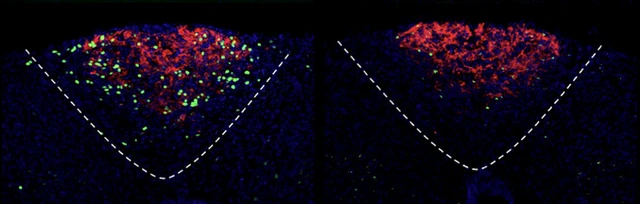
Dr. Timo Müller and his team shed light on the underlying molecular mechanisms and the role of GIP. In their new study, the researchers demonstrate that GIP acts in the brainstem via specific inhibitory neurons. In detail, the GIPR:GLP-1R co-agonist reduces body weight and food intake through GIPR signaling in inhibitory neurons in the brain, the so-called GABAergic neurons. If the GIPR is absent in these GABAergic neurons, the weight-reducing effects of GIP vanish.

“For the first time, these data illustrate that GIP regulates body weight and food intake in the brain by stimulating GABAergic neurons and emphasizes the necessity of the GIPR on these neurons for this ability to decrease body weight and food intake”, says Timo Müller, senior author of the paper. “Our data offer valuable insights into the mechanisms of GIPR:GLP-1R co-agonists, which can now be used to specifically target the brain GIP system for next generation anti-obesity drugs”, adds Arek Liskiewicz, first author of the study.


Original publication

Liskiewicz et al. (2023): Glucose-dependent insulinotropic polypeptide (GIP) regulates body weight and food intake via GABAergic neurons in mice. Nature Metabolism. DOI: 10.1038/s42255-023-00931-7


About the scientists

PD Dr. Timo Müller, Head of Division of Molecular Pharmacology at the Institute for Diabetes and Obesity at Helmholtz Munich and Researcher at the German Center for Diabetes Research (DZD)

Dr. Arek Liskiewicz, Postdoctoral Scientist at the Division of Molecular Pharmacology at the Institute for Diabetes and Obesity at Helmholtz Munich and at the German Center for Diabetes Research (DZD)

Prof. Timo Müller
Prof. Dr. Timo Müller

Institute Director

View profile

Related news

IDR Beta cell Heterogeneity

New Research Findings, Diabetes, IDR, IDO,

Rising Focus on 'Inceptor' as a Type 2 Diabetes Therapeutic Target

Research targeting the insulin-inhibitory receptor, called inceptor, unveils promising avenues for beta cell protection, offering hope for causal diabetes therapy. A novel study in mice with diet-induced obesity demonstrates that the knock-out of…

Fork with measuring tape around on pink background

Transfer, HI-MAG, IDO,

Science Has Named GLP-1 Drugs the Breakthrough of the Year

2023 has changed the way we treat obesity. A new class of drugs, mimicking a gut hormone called glucagon-like peptide-1 (GLP-1), is reshaping medicine and improving many people’s lives globally. GLP-1 drugs do not only induce significant weight loss,…

Portrait Timo Müller

Awards & Grants, Diabetes, IDO,

Regulation of Energy and Glucose Metabolism: Timo Müller Honored with Minkowski Prize Awarded by the EASD

Diabetes researcher Dr. Timo Müller was honored with the 58th Minkowski Prize awarded by the EASD for his distinction manifested by publications that contribute to the advancement of knowledge concerning diabetes.

IDO Labor Gelber Handschuh

New Research Findings, IDO,

Unraveling the Mode of Action of Tirzepatide

Tirzepatide is a recently approved treatment for type-2 diabetes. Treatment with tirzepatide decreases body weight while improving glucose metabolism in patients with obesity and type-2 diabetes. Although the drug is designed to activate receptors…

Timo Müller Werner-Creutzfeldt-Preis 190523_DMD_12268

Awards & Grants, IDO,

Timo Müller Awarded with Werner Creutzfeldt Prize

The German Diabetes Society (DDG) awards this year's Werner Creutzfeldt Prize to Helmholtz Munich scientist PD Dr Timo Müller for his exceptional work in the research field of Incretin-based diabetes and obesity. This is already the second time in a…