Environmental Risks
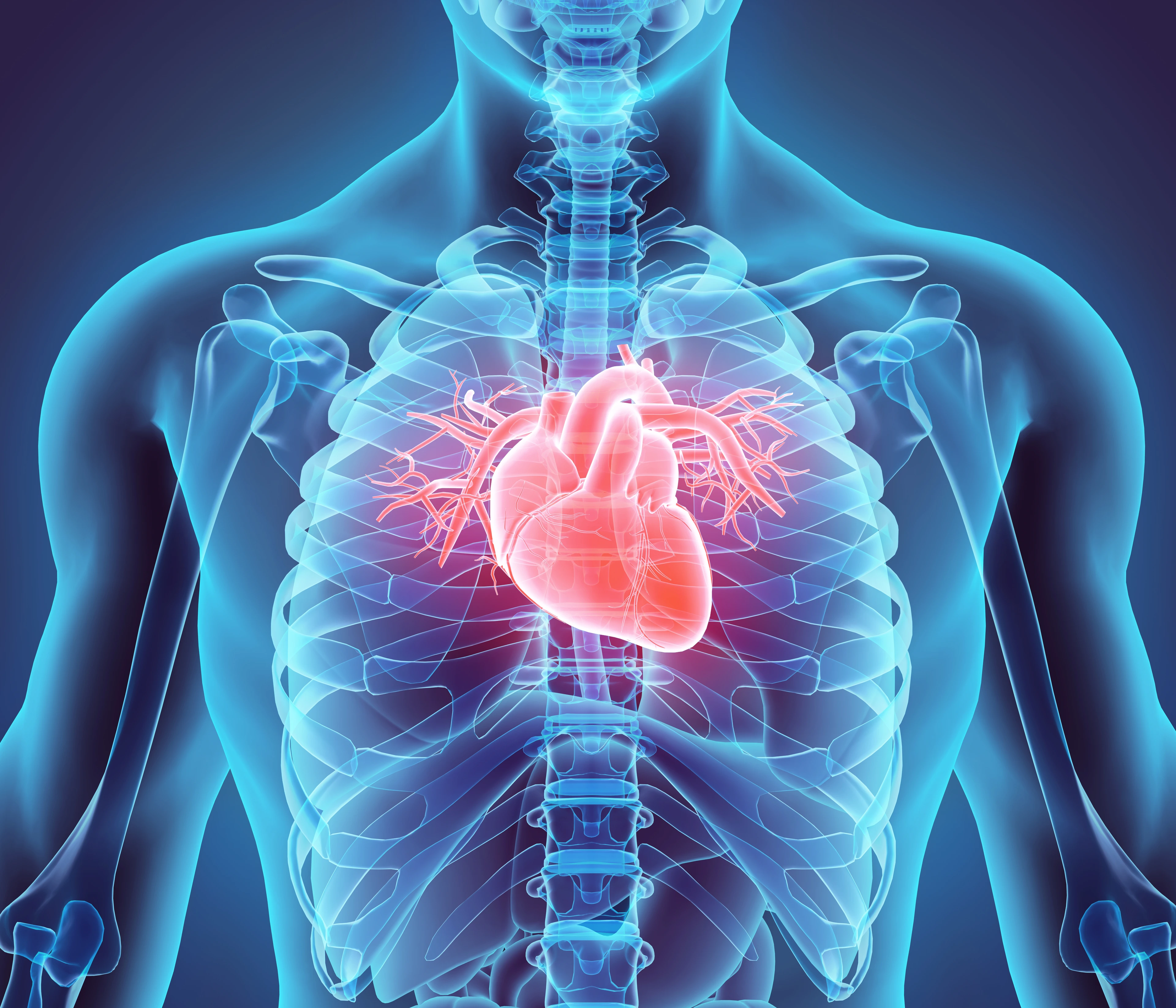
We investigate how environmental factors like air pollution, temperature, weather events, climate change, noise, and green space affect health, with a focus on cardiovascular and metabolic diseases in adults.
About our Research
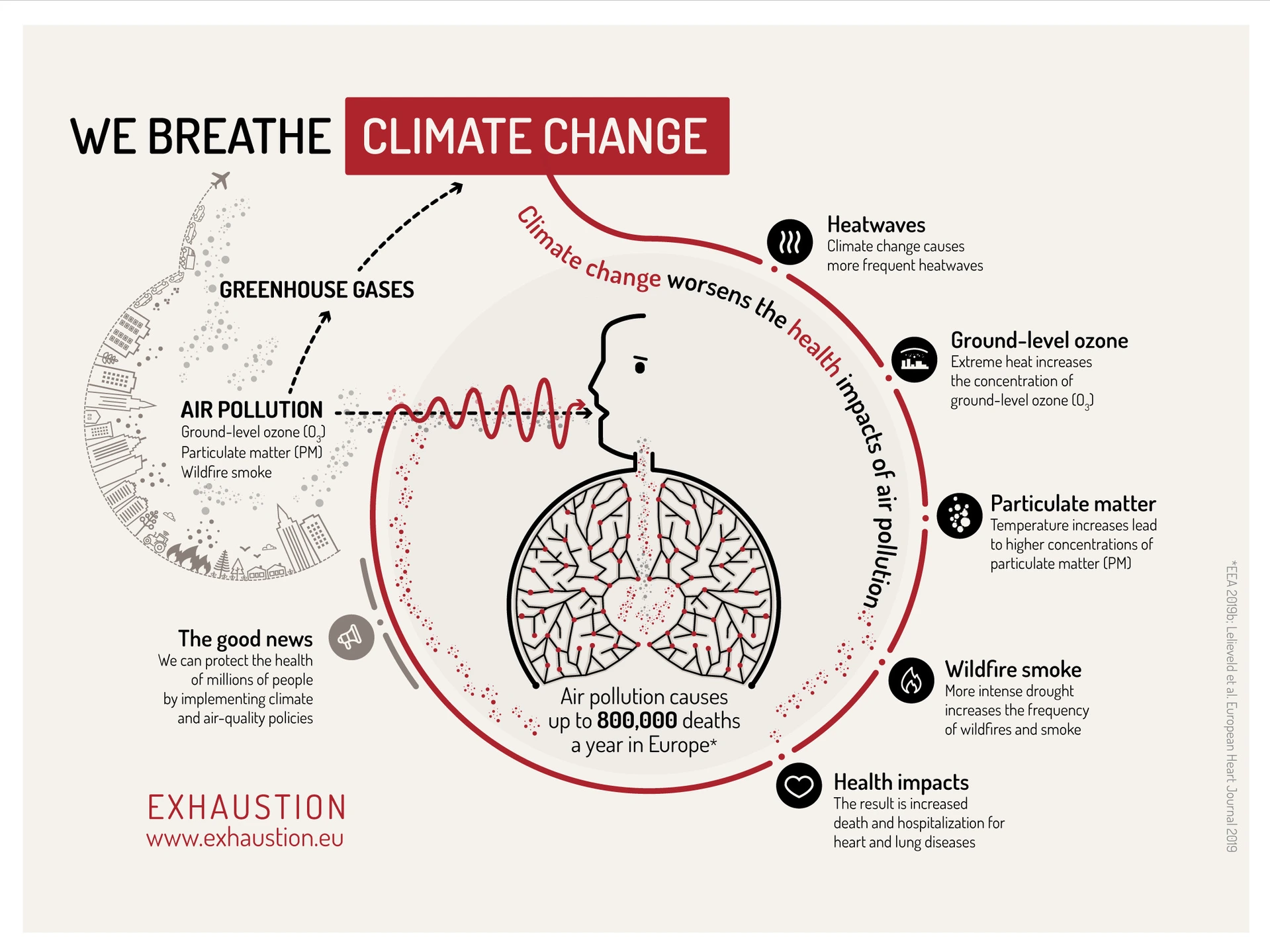
The environments where we live and work can profoundly affect our health. While quiet, green environments with good air quality can promote good health and wellbeing, environments with air pollution, traffic and industrial noise, extreme temperatures, and extreme weather events can cause a variety of health problems. Even small amounts of air pollution, low levels of noise, and less intense exposure to summer heat or winter cold can lead to poor health outcomes in some vulnerable groups. Environmental exposures can sometimes also work together to create better or worse health outcomes – for example, the combination of air pollution and high temperatures is especially bad for our health.
In our working group, we study the short- (acute) and long-term (chronic) beneficial and adverse health impacts of environmental factors such as air pollution, meteorology, climate change, noise, and urban greenness. We study the impact of the environment on a variety of health outcomes, but focus in particular on cardiovascular, metabolic, and mental health in adults. We aim to provide new evidence on the interplay between environmental factors, exposure-response functions, underlying health mechanisms, and subclinical phenotypes. We also investigate differences by sex or gender, and whether certain population subgroups (such as the elderly, children, or people with chronic illnesses) are especially susceptible.
Our Topics
People at Environmental Risks
Deputy Director of the Institute of Epidemiology, Head of Research Group 'Environmental Risks', Senior Scientist, EPI
View profilePostdoctoral Researcher

Visiting Researcher

PhD Student

Senior Scientist

Postdoctoral Researcher

PhD Student

PhD Student
PhD Student

Data Manager

Scientist

PhD Student

Senior Scientist
Data Manager

Completed Projects
Highlighted Publications
He C, Breitner S, Zhang S, Huber V, Naumann M, Traidl-Hoffmann C, Hammel G, Peters A, Ertl M, Schneider A.
Nocturnal heat exposure and stroke riskNi W, Stafoggia M, Zhang S, Ljungman P, Breitner S, Bont J, Jernberg T, Atar D, Agewall S, Schneider A.
Short-Term Effects of Lower Air Temperature and Cold Spells on Myocardial Infarction Hospitalizations in SwedenSchwarz M, Peters A, [...], Schneider A, Breitner S; MCC Collaborative Research Network.
Temporal variations in the short-term effects of ambient air pollution on cardiovascular and respiratory mortality: a pooled analysis of 380 urban areas over a 22-year periodHe C, Breitner-Busch S, Huber V, Chen K, Zhang S, [...], Schneider A.
Rainfall events and daily mortality across 645 global locations: two stage time series analysisStafoggia M, Analiti A, Chen J, Rodopoulou S, Brunekreef B, Hoek G, Wolf K, Samoli E.
Comparing “causal” and “traditional” approaches in the association of long-term exposure to ambient air pollution on mortality: How sensitive are the results?Schwarz M, Schneider A, Cyrys J, Bastian S, Breitner S*, Peters A*.
Impact of Ambient Ultrafine Particles on Cause-Specific Mortality in Three German CitiesNikolaou N, Dallavalle M, Stafoggia M, [...], Peters A, Chen K, Wolf K, Schneider A.
High-resolution spatiotemporal modeling of daily near-surface air temperature in Germany over the period 2000–2020Ni W, Nikolaou N, Ward-Caviness C, Breitner-Busch S, Wolf K, Zhang S, Wilson R, Waldenberger M, Peters A, Schneider A.
Associations between medium- and long-term exposure to air temperature and epigenetic age accelerationRai M, Breitner S, Wolf K, Peters A, Schneider A, Chen K.
Future temperature-related mortality considering physiological and socioeconomic adaptation: a modelling frameworkZhang S, Breitner S, Pickford R, Lanki T, Okokon E, Morawska L, Samoli E, Rodopoulou S, Stafoggia M, Renzi M, Schikowski T, Zhao Q, Schneider A, Peters A.
Short-term effects of ultrafine particles on heart rate variability: A systematic review and meta-analysisChen K, Dubrow R, Breitner S, Wolf K, Linseisen J, Schmitz T, Heier M, von Scheidt W, Kuch B, Meisinger C, Peters A, KORA study group, Schneider A.
Triggering of myocardial infarction by heat exposure is modified by medication intakeZhang S, Mwiberi S, Pickford R, Breitner-Busch S, Huth C, [...], Cyrys J, Peters A, Wolf K, Schneider A.
Longitudinal associations between ambient air pollution and insulin sensitivity: Results from the KORA cohort studyContact Head
Deputy Director of the Institute of Epidemiology, Head of Research Group 'Environmental Risks', Senior Scientist, EPI
alexandra.schneiderspam prevention@helmholtz-munich.de
Building / Room: 56, 247
Contact Deputy Head
Senior Scientist; Deputy Head of Research Group 'Environmental Risks'
kathrin.wolfspam prevention@helmholtz-munich.de
Building / Room: 56, 247a