
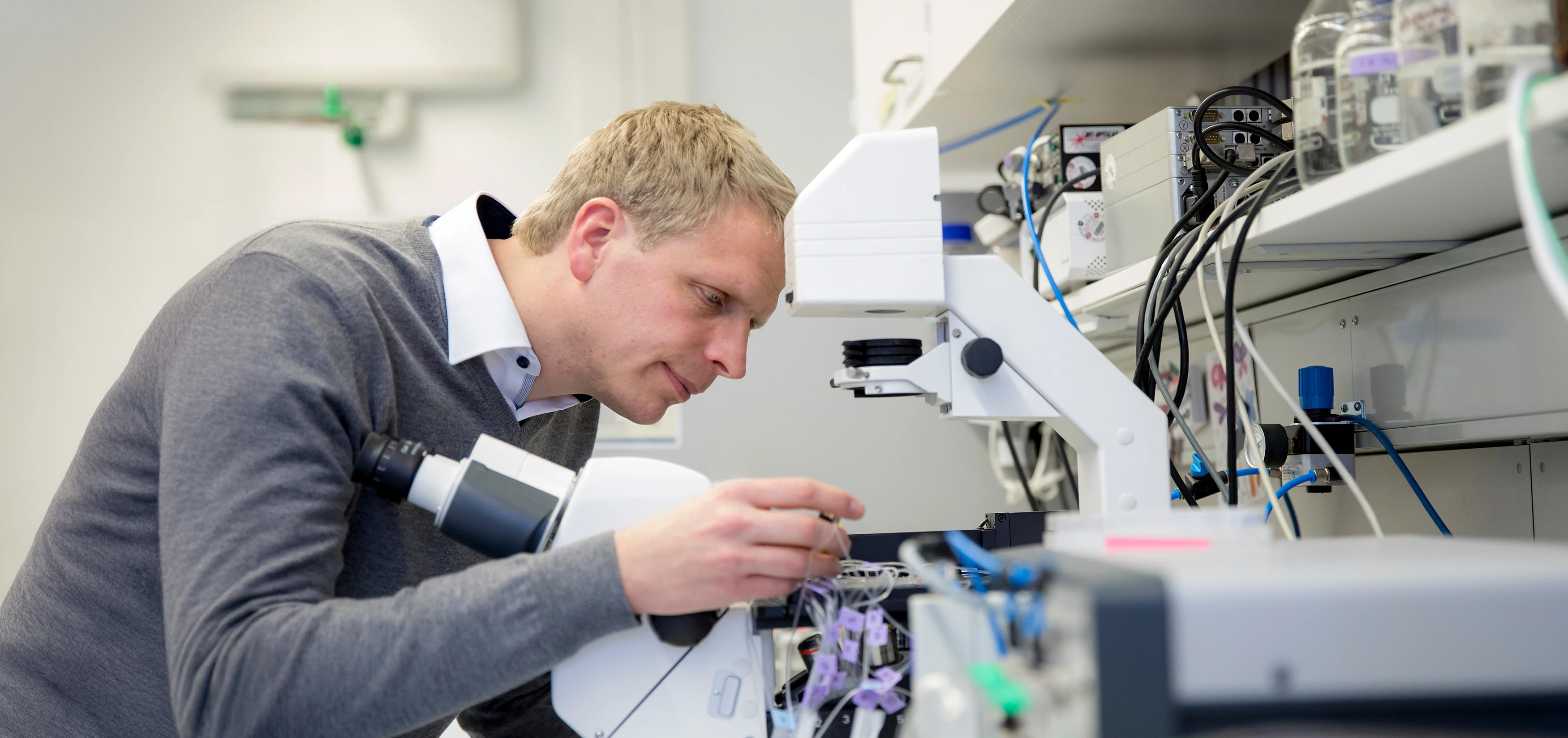
Principal Investigator Helmholtz Pioneer Campus
Prof. Dr. Matthias Meier
Forschungsgebiet
Matthias Meier ist ein deutscher Biophysiker, der 2006 an der Universität Basel promovierte. 2008 erhielt er das Feodor-Lynen-Postdoktorandenstipendium der Alexander-von-Humboldt-Stiftung und arbeitete anschließend vier Jahre lang mit Steven Quake an der Stanford University zusammen. Mithilfe eines Emmy-Noether-Stipendiums der Deutschen Forschungsgemeinschaft kehrte er nach Europa zurück und gründete eine unabhängige Forschungsgruppe am Institut für Mikrosystemtechnik der Universität Freiburg. 2017 erhielt er den ERC Consolidator Grant für seine Forschung im Bereich der Medizintechnik mit dem Schwerpunkt Organ-on-Chips. 2018 trat er dem Helmholtz Pioneer Campus bei.

Beruflicher Hintergrund
Full Professorship at the Institut of Biochemistry of the University of Leipzig
Principal Investigator at Helmholtz Pioneer Campus, Helmholtz Munich
Independent Research Group Leader (DFG Emmy-Noether Fellow) at IMTEK, University of Freiburg, Germany
Postdoc at Stanford University, Laboratory of Professor Stephen Quake, USA
Postdoc at University of Chicago, Laboratory of Professor Rustem Ismagilov, USA
Publications
Zitzmann, F.D. ; Remmert, C. ; Rogers, N.K. ; Schmidt, S. ; Lickert, H. ; Jahnke, H.G. ; Meier, M.
Real-time, label-free impedimetric monitoring of insulin secretion from three-dimensional stem cell–derived islets.Allgöwer, C. ; Mulaw, M.A. ; Nagai, J. ; Wiedenmann, S. ; Ringel, E.A. ; Ferrara, B. ; Piemonti, L. ; Maulana, T.I. ; Ferreira, L.T. ; Flinders, A. ; Teufel, C. ; Reichardt, L. ; Lopatta, P.B. ; Srinivasan, D. ; Lahusen, A. ; Seufferlein, T. ; Gaisa, N.T. ; Beck, A. ; Lindenmayer, J. ; Melzer, M.K. ; Zimmer, E. ; Roger, E. ; Heller, S. ; Löhr, J.M. ; Liebau, S. ; Loskill, P. ; Lin, Y.N. ; Camisa, P.R. ; Jorgensen, C. ; Crippa, S. ; Meier, M. ; Hohwieler, M. ; Costa, I.G. ; Breunig, M. ; Kleger, A.
An oncogenic KRAS-driven secretome involving TNFα promotes niche preparation prior to pancreatic cancer onset.Papa, C. ; Rose, A. ; Martin, H.N.G. ; Useini, A. ; Geier, F. ; Liao, L. ; Rodriguez Aguilera, J.R. ; Valina-Allo, P. ; Hoffmann, A. ; Tvardovskiy, A. ; Zulfqar, F. ; Zimmerman, A. ; Schicht, G. ; Ott, F. ; Körner, C. ; Engelmann, B. ; Rolle-Kampczyk, U. ; von Bergen, M. ; Meier, M. ; Bartke, T. ; Seehofer, D. ; Klöting-Blüher, N. ; Matz-Soja, M. ; Damm, G. ; Boeckel, J.N. ; Buescher, J.M. ; Blüher, M. ; Laufs, U. ; Bondareva, O. ; Sträter, N. ; Künze, G. ; Heiker, J.T. ; Sheikh, B.N.
Bempedoic acid directly binds and activates PPARα.Schneider, M.R. ; Meier, M.
Bringing high-resolution spatial order to sebaceous glands.Remmert, C. ; Otgonbayar, M. ; Perschel, J.A. ; Marder, M. ; Meier, M.
Protocol to generate a microfluidic vessels-on-chip platform using human pluripotent stem cell-derived endothelial cells.Marder, M. ; Remmert, C. ; Perschel, J.A. ; Otgonbayar, M. ; von Toerne, C. ; Hauck, S.M. ; Bushe, J. ; Feuchtinger, A. ; Sheikh, B.N. ; Moussus, M. ; Meier, M.
Stem cell-derived vessels-on-chip for cardiovascular disease modeling.Schmidt, S. ; Li, W. ; Schubert, M. ; Binnewerg, B. ; Prönnecke, C. ; Zitzmann, F.D. ; Bulst, M. ; Wegner, S. ; Meier, M. ; Guan, K. ; Jahnke, H.G.
Novel high-dense microelectrode array based multimodal bioelectronic monitoring system for cardiac arrhythmia re-entry analysis.Zitzmann, F.D. ; Schmidt, S. ; Frank, R. ; Weigel, W. ; Meier, M. ; Jahnke, H.G.
Microcavity well-plate for automated parallel bioelectronic analysis of 3D cell cultures.Hörner, M. ; Becker, J. ; Bohnert, R. ; Baños, M. ; Jerez-Longres, C. ; Mühlhäuser, V. ; Härrer, D. ; Wong, T.W. ; Meier, M. ; Weber, W.
A photoreceptor-based hydrogel with red light-responsive reversible sol-gel transition as transient cellular matrix.Rosowski, S. ; Remmert, C. ; Marder, M. ; Akishiba, M. ; Bushe, J. ; Feuchtinger, A. ; Platen, A. ; Ussar, S. ; Theis, F.J. ; Wiedenmann, S. ; Meier, M.
Single-cell characterization of neovascularization using hiPSC-derived endothelial cells in a 3D microenvironment.