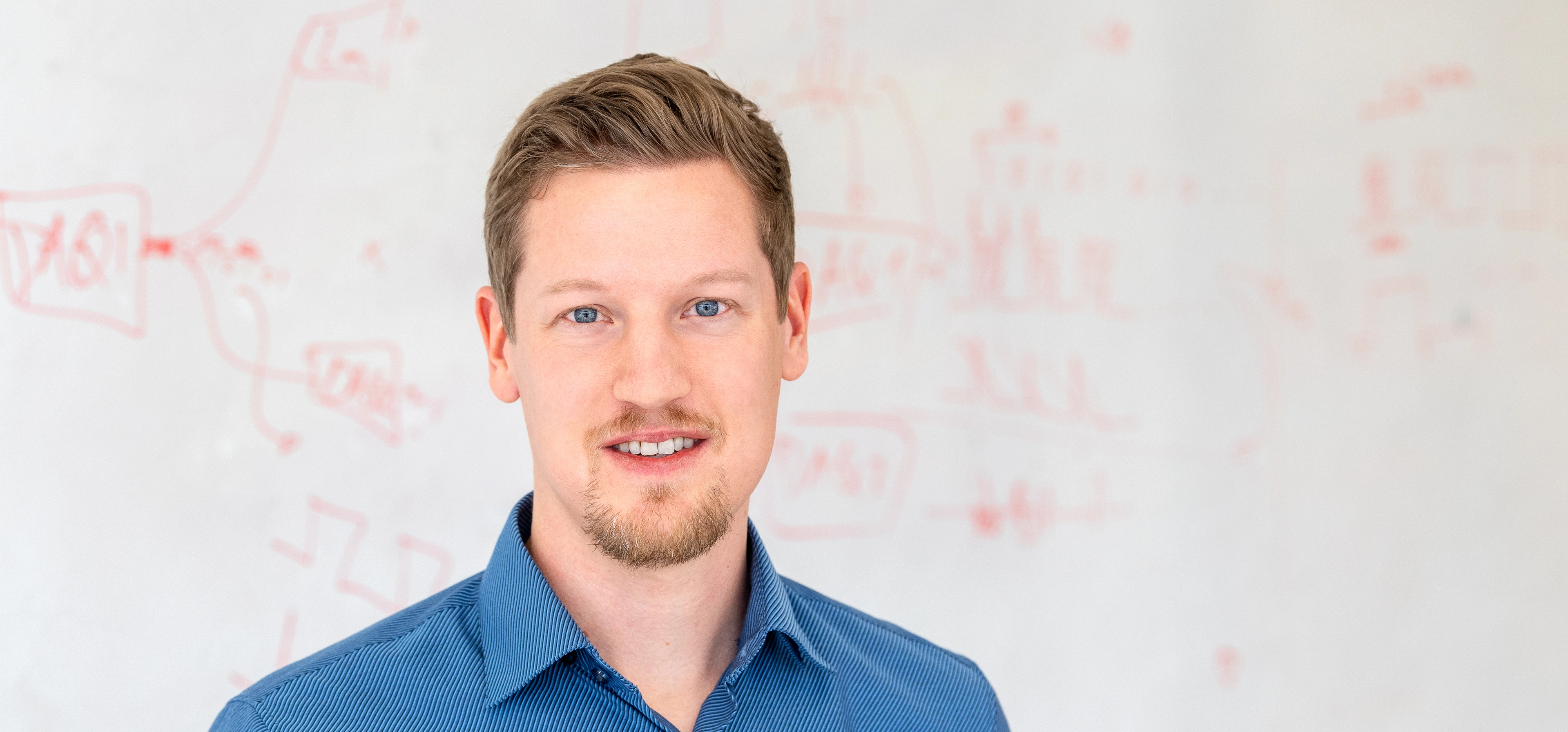
Dominik Jüstel
“Clinical translation of biomedical technology needs efficient and robust computational tools, which rely on deep mathematics.”
Research Focus
Dominik Jüstel’s research lies at the interface between computational mathematics and biomedical imaging with a focus on clinical applications of optoacoustic imaging and sensing. Combining the unique abilities of optoacoustic technology with computational tools, Dominik and his team extract clinically relevant information from imaging and sensing data.
From pure mathematics to translational medical imaging
Dominik Jüstel studied mathematics and informatics at the Technical University of Munich, graduating at the Chair for Mathematical Modeling of Biological Systems at TUM and the Institute for Biomathematics and Biometry at Helmholtz Munich. He received his doctoral degree (Dr. rer. nat.) with highest distinction for his work on mathematical models and design problems in molecular X-ray diffraction imaging at the Chair for Analysis at the mathematics faculty of TUM.
Dominik holds a tenure track position for ‘AI in optoacoustics’ at the Institute for Biological and Medical Imaging and the Institute for Computational Biology at Helmholtz Munich, and is also affiliated with the Chair for Biological Imaging at TUM. With his group at the interdisciplinary research center TranslaTUM, he works on computational methods and advanced data analysis for various optical and optoacoustic imaging and sensing modalities.
Collaborating with multiple clinical institutions and industrial partners, his group is a driving force for the translation of optoacoustic technology to the clinic by providing computational solutions for translational problems.
Skills
Mathematics Machine learning Artificial Intelligence Medical Imaging Optoacoustics Inverse Problems Sensing
Professional Background
ERC Starting Grant ‘EchoLux’
on the topic ‘Intelligent Optoacoustic Radiomics via Synergistic Integration of System Models and Medical Knowledge’ with the clinical use case MSOT imaging of peripheral neuropathy
Tenure Track ‘AI in Optoacoustics’
to leverage the advances in machine learning and artificial intelligence for optoacoustic imaging and sensing
group leader at the Institute of Biological and Medical Imaging
Honors and Awards
- 2022 VIP+
- 2021 ERC Starting Grant
- 2020 Medical Valley Award