
Abstract
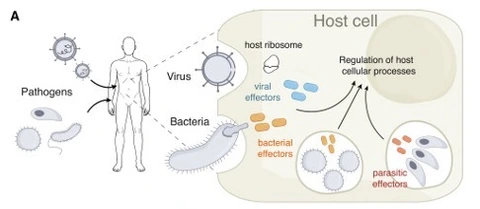
Pathogens deploy effector proteins to exploit host cell biology, and most effector open reading frames (ORFs) are rapidly evolving and lack functional annotation. We developed the effector ORFeome (eORFeome), a scalable functional genomics platform encompassing 3,835 effector ORFs from diverse viruses, bacteria, and parasites. High-throughput barcoded screens across nuclear factor κB (NF-κB), apoptosis, p53, cGAS-STING, and major histocompatibility complex class I (MHC class I) pathways revealed novel pathway-modulating functions for hundreds of uncharacterized eORFs, unexpected activities of known effectors, and distinct pathway-specific functions encoded by single ORFs. Illustrating the power of this approach, we identified HHV6A U14 as a p53 antagonist, HHV7 U21 as a dual-function STING antagonist and MHC-I antigen display inhibitor, and adenoviral 13.6K/i-leader protein as a de novo-evolved TAP inhibitor that suppresses MHC-I display. These results establish a general framework for systematic effector annotation, uncover new mechanisms of host-pathogen interaction across kingdoms, and highlight pathogen effectors as a versatile toolkit for rewiring and probing human cellular pathways.