Spotting the Missteps: How MiROM Detects Protein Misfolding in Cancer Cells
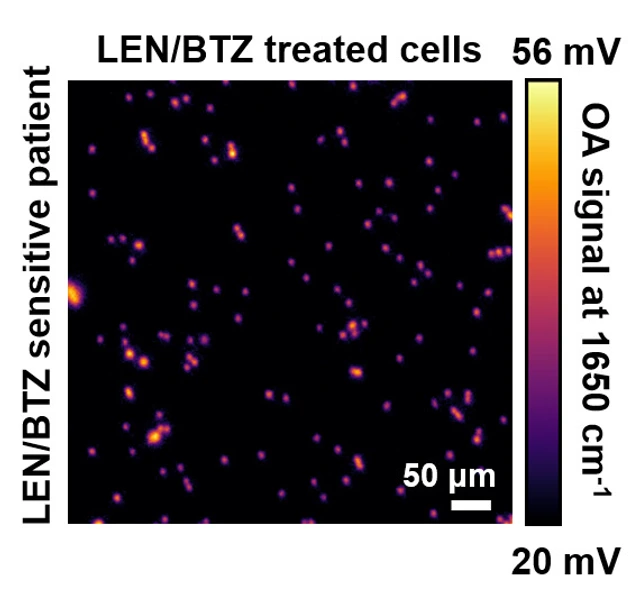
MiROM identifies proteins by using mid-infrared light to detect molecular vibrations – essentially the natural “dance” of molecules within protein structures. Unlike optical spectroscopy, which measures light attenuation, optoacoustics capture ultrasound waves generated when proteins absorb infrared light. This absorption causes a tiny, localized temperature increase, leading to transient expansion of medium surrounding the protein and the emission of ultrasound waves. By analyzing these signals in real time, MiROM can detect structural changes in proteins, such as misfolding, by recognizing shifts in their molecular “dance”. This capability provides crucial insights into how cancer cells respond to treatment.
Overcoming Limitations in Myeloma Therapy Assessment
Multiple myeloma is a blood cancer that affects plasma cells in the bone marrow, leading to abnormal protein production, weakened immunity, and organ damage. Traditional methods for evaluating myeloma treatment often require large cell samples, complex preparation, and time-intensive measurements, making it challenging to monitor individual patient responses in a timely manner.
MiROM overcomes these limitations by analyzing single cells, requiring only a minimal number of patient samples, and providing fast, nearly real-time assessments of treatment effectiveness.
“Since MiROM can analyze individual cells in real time without the need for elaborate sample preparation, it offers fast insights into how treatments may impact protein structures at a cellular level,” says Francesca Gasparin, first author of the study. “Specifically, MiROM detects the formation of intermolecular beta-sheets (structures linked to protein misfolding) as well as apoptosis, the programmed cell death that indicates whether cancer treatments are working or if drug resistance is developing,” add Prof. Miguel Pleitez and Prof. Florian Basserman, senior investigators in the study.
By analyzing individual cells, MiROM can uncover variations in treatment response within a patient’s cancer, paving the way for personalized therapy adjustments.
One Tool, Many Applications
Beyond multiple myeloma, MiROM holds great potential for other diseases linked to protein misfolding, including Alzheimer’s and Parkinson’s. Ongoing advancements – including optimizing laser pulse duration and increasing imaging speed – could further enhance its sensitivity and broaden its clinical applications.
“We envision the use of MiROM in drug screening, diagnostic tests and home-based patient monitoring,” says Prof. Vasilis Ntziachristos, also a senior investigator in the study. Future clinical validation in larger patient cohorts will be the next step toward bringing this technology into routine medical practice.
Original Publication
Gasparin et al., 2025: Label-free protein-structure-sensitive live-cell microscopy for patient-specific assessment of myeloma therapy. Nature Biomedical Engineering. DOI: 10.1038/s41551-025-01443-3