T cells Respond Earlier Than Assumed
T‑cell activation has long been seen as a relatively late step in antiviral defense. While the innate immune system reacts immediately, CD8 T cells are part of the adaptive response and usually act only after several days, targeting infected cells.
Researchers at the Institute of Lung Health and Immunity (LHI, Helmholtz Munich) and the Research Center Borstel (Leibniz Lung Center) now show that these cells can respond much earlier. They react to viral components far sooner than expected.
Live Imaging Tracks CD8 T-Cell Mobilization
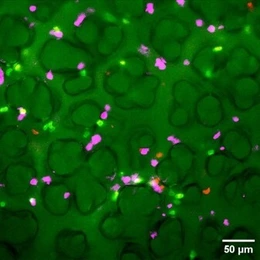
The discovery was made possible by high-resolution intravital microscopy. This technique - available at only a few sites worldwide - allows biological processes to be observed directly in living organisms, in real time.
The team tracked how immune cells behave in the first hours after contact with viral components and what happens in the lung. The focus was on the SARS‑CoV‑2 envelope (E) protein, a structural component of the viral shell.
Within four hours of exposure to this protein, CD8 T cells were activated. They migrated into the lung, remained there for an extended time, and formed local clusters.
Innate Signaling Triggers Rapid Activation
The mechanism behind this rapid response was unexpected. The activation of CD8 T cells did not follow the known pathways of adaptive immunity. Instead, the innate immune system detects the E protein via the receptor TLR2 and triggers signals that activate T cells within hours.
Such rapid activation is typical for innate immune cells but had not been described for T cells in this way. The study therefore identifies a new mechanism by which viral structural proteins can induce a fast, innate-like T‑cell response.
“High-resolution intravital microscopy allows us to directly observe immune cell behavior in the lung and better understand how pulmonary immune responses unfold,” says Markus Rehberg, group leader at LHI and researcher in the German Center for Lung Research (DZL).
“Our results suggest that innate and adaptive immunity work hand in hand much earlier than previously thought,” adds Silke Meiners, head of the Immunology and Cell Biology group at the Research Center Borstel.
Outlook: What Does This Mean?
In short, viral proteins can shape immune responses in the lung at a very early stage. Here, the SARS‑CoV‑2 envelope protein activates CD8 T cells before the immune system has fully recognized the virus. This opens up several perspectives:
- monitoring immune responses at the earliest stage of infection
- assessing disease risk more precisely
- targeting the interaction between innate and adaptive immunity in therapy
Original Publication
Shaalan et al., 2026: SARS-CoV-2 (E)-protein induces rapid TLR2-mediated T cell activation in mouse lungs revealed by intravital lung microscopy. ERS Publications. DOI: 10.1183/13993003.01064-2025