Tracking the First Responders
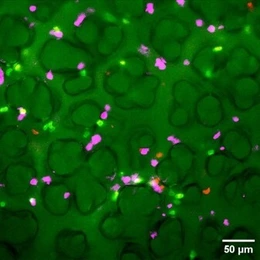
Airborne fine particles and nanoparticles are closely linked to respiratory and cardiovascular diseases. Researchers led by Prof. Markus Rehberg and Dr. Qiongliang Liu from the LHI at Helmholtz Munich have now shown that inhaled nanoparticles do not spread evenly through the lungs but accumulate in specific hotspots deep in the alveoli. At these sites, alveolar macrophages quickly migrate toward the particles, engulf them, and release chemical signals that recruit neutrophils, another type of immune cell, to the same location.
Macrophages Drive Inflammation
The researchers found that macrophage mobility and phagocytosis are essential for triggering inflammation. When macrophage movement was blocked – or when receptors needed for particle uptake were inhibited – neutrophil recruitment was almost completely prevented. Likewise, using “stealth” nanoparticles that evade recognition blunted the immune response.
These findings show that macrophages act as key conductors of the lung’s first immune reaction: without their movement or uptake of nanoparticles, inflammation does not begin.
A Rapid, Pre-Loaded Defense
Rather than activating new genes, macrophages rely on pre-stored inflammatory molecules such as TNF-alpha and CXCL chemokines. This enables an ultra-fast, localized response, much like deploying a pre-packed emergency kit. Inhibiting this release with the drug cromolyn blocked neutrophil recruitment.
A Localized and Efficient Response
Alveolar macrophages are not passive cleaners but active sentinels that sense and shape immune reactions in the lungs. Their mobility, phagocytic activity, and communication with epithelial cells determine where and when inflammation occurs. Because the reaction remains confined to nanoparticle deposition sites, it represents a highly targeted defense mechanism.
Implication for Health and Research
These insights reveal how air pollutants and engineered nanoparticles provoke lung inflammation. Understanding these processes could help develop strategies to modulate macrophage activity, reducing harmful inflammation while maintaining essential immune protection.
Original publication
Liu et al., 2025: Alveolar macrophages initiate the spatially targeted recruitment of neutrophils after nanoparticle inhalation. Science Advances. DOI: 10.1126/sciadv.adx8586