Group Leader, Institute of Functional Epigenetics
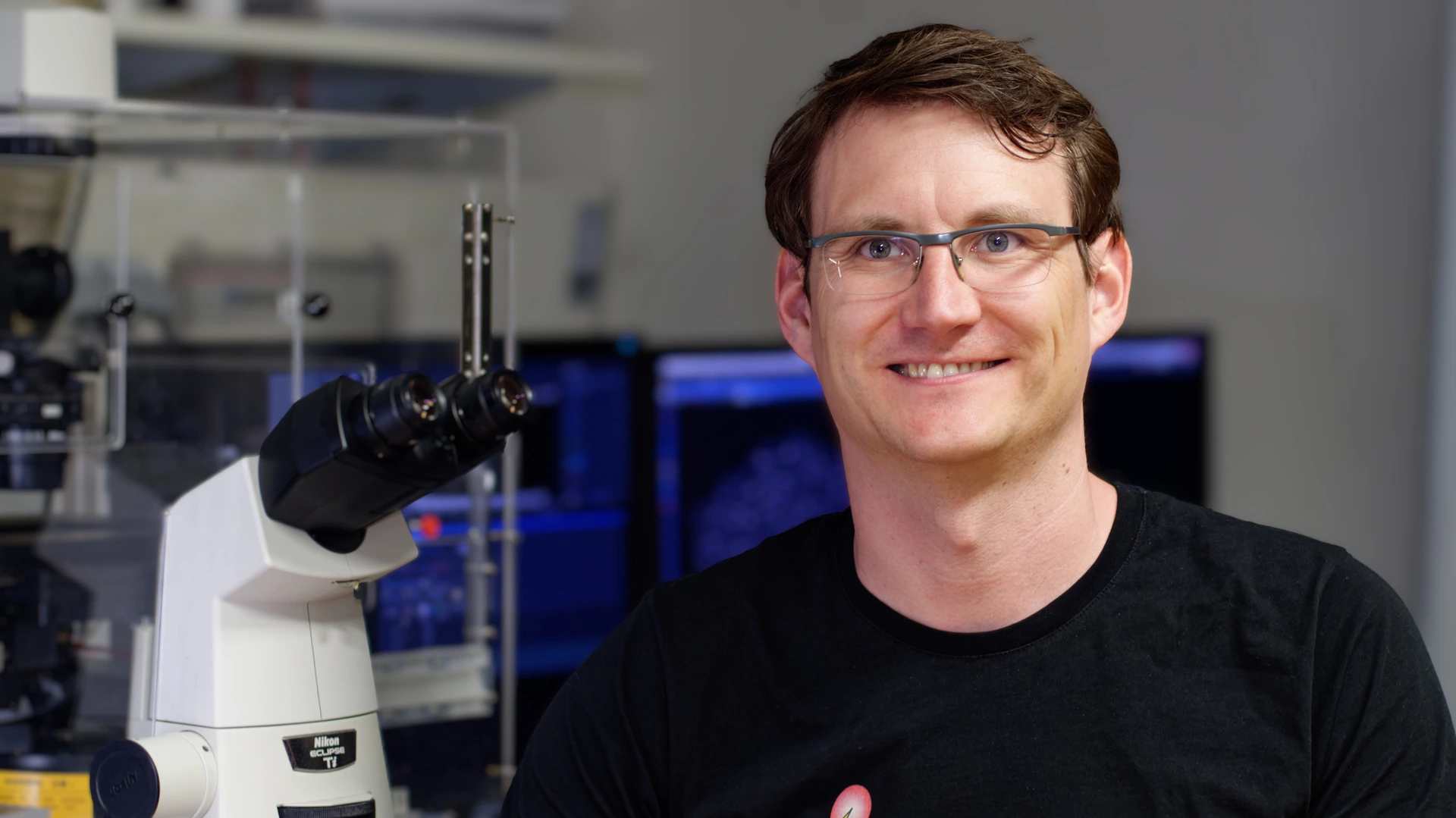
Dr. Kurt Schmoller
“We use quantitative biology, single-cell imaging, and AI-driven analysis to understand how cell size is regulated and how it governs cell function and human health.”
Academic Career and Research Areas
Kurt Schmoller studied biophysics at the Technical University Munich, where he also obtained his PhD for his work on non-equilibrium in vitro reconstituted cytoskeletal systems. During his postdoc with Jan Skotheim at Stanford University he became interested in the regulation of cell size. Using quantitative live-cell time-lapse microscopy, he identified dilution of the cell cycle inhibitor Whi5 as a mechanism by which budding yeast cells can sense their own size.
In 2017, he started his own research group at Helmholtz Munich, where he extended his research focus beyond cell size regulation to the question of how changes in cell size impact cellular processes and function. For example, the group’s work obtained mechanistic insight into how organelles such as mitochondria and the actomyosin ring responsible for cell division are regulated with cell size, and how cell size affects transcription and protein synthesis. Supported by an ERC consolidator grant, a major current focus of the lab is to understand the coregulation of cell size, mitochondria and mitochondrial DNA, and their impact on cell function and human health.
Bridging the gap between AI research and application by cell biology experimentalists, Kurt and his team also drive the development of AI-based image analysis solutions for live-cell microscopy.
Fields of Work and Expertise
Quantiative cell biology
live cell microscopy
image analysis
AI
mitochondria
protein homeostasis
cell size
cell cycle
yeast
algae
Professional Background
Group Leader, Institute of Functional Epigenetics, Helmholtz Munich (Germany)
Postdoc, Skotheim Lab, Stanford University, USA
Dr. rer. nat., Physics, TU München, Germany
Honors and Awards
- 2024 - ERC Consolidator Grant “MITOSIZE”
- 2020 - Helmholtz ERC Recognition Award
- 2019 - HFSP Career Development Award
2013 - HFSP Postdoctoral Fellowship

Recent Publications
Padovani, F. ; Čavka, I. ; Neves, A.R.R. ; López, C.P. ; Al-Refaie, N. ; Bolcato, L. ; Chatzitheodoridou, D. ; Chadha, Y. ; Lagos, P. ; Stegmaier, T. ; Su, X.A. ; Lengefeld, J. ; Cabianca, D.S. ; Köhler, S. ; Schmoller, K.M.
SpotMAX: A generalist framework for multidimensional automatic spot detection and quantification.Moukham, H. ; Caligaris, M. ; Six, P. ; Padovani, F. ; Schmoller, K.M. ; Virgilio, C.D. ; Nicastro, R. ; Tripodi, F. ; Coccetti, P.
SNF1/AMPK controls its own localization by phosphorylating its activating kinase Sak1.Wunder, T. ; Eulitz, L. ; Kramer, L. ; Ali, Z.M. ; Ostermeier, M. ; Leu, C. ; Szulc, B. ; Holzner, L.J. ; Fechter, J. ; Padovani, F. ; Brandt, B. ; Girr, P. ; Teh, J.T. ; Mühlbauer, S. ; Sotos, C. ; Angstenberger, M. ; Mackinder, L.C.M. ; Schmoller, K.M. ; Rädler, J.O. ; Nickelsen, J. ; de Vries, J. ; Kunz, H.H.
Conserved and lineage-specific roles of KEA-mediated Ion homeostasis in chlamydomonas.Dengler, L. ; Padovani, F. ; Lemke, B. ; Brugger, R. ; Benedikt, A. ; Westermann, B. ; Maček, B. ; Schmoller, K.M. ; Ewald, J.C.
In the absence of mitochondrial fusion unequal segregation of mitochondria drives mtDNA loss.Kim, J. ; Xie, S. ; Valenzuela, L.F. ; Xiao, J. ; Lanz, M.C. ; Gao, X. ; Swaffer, M. ; Mitchell, C.E. ; Rubin, S.M. ; Schmoller, K.M. ; Skotheim, J.M.
A Fkh1/2 binding site array in the WHI5 promoter drives sub-scaling transcription.