
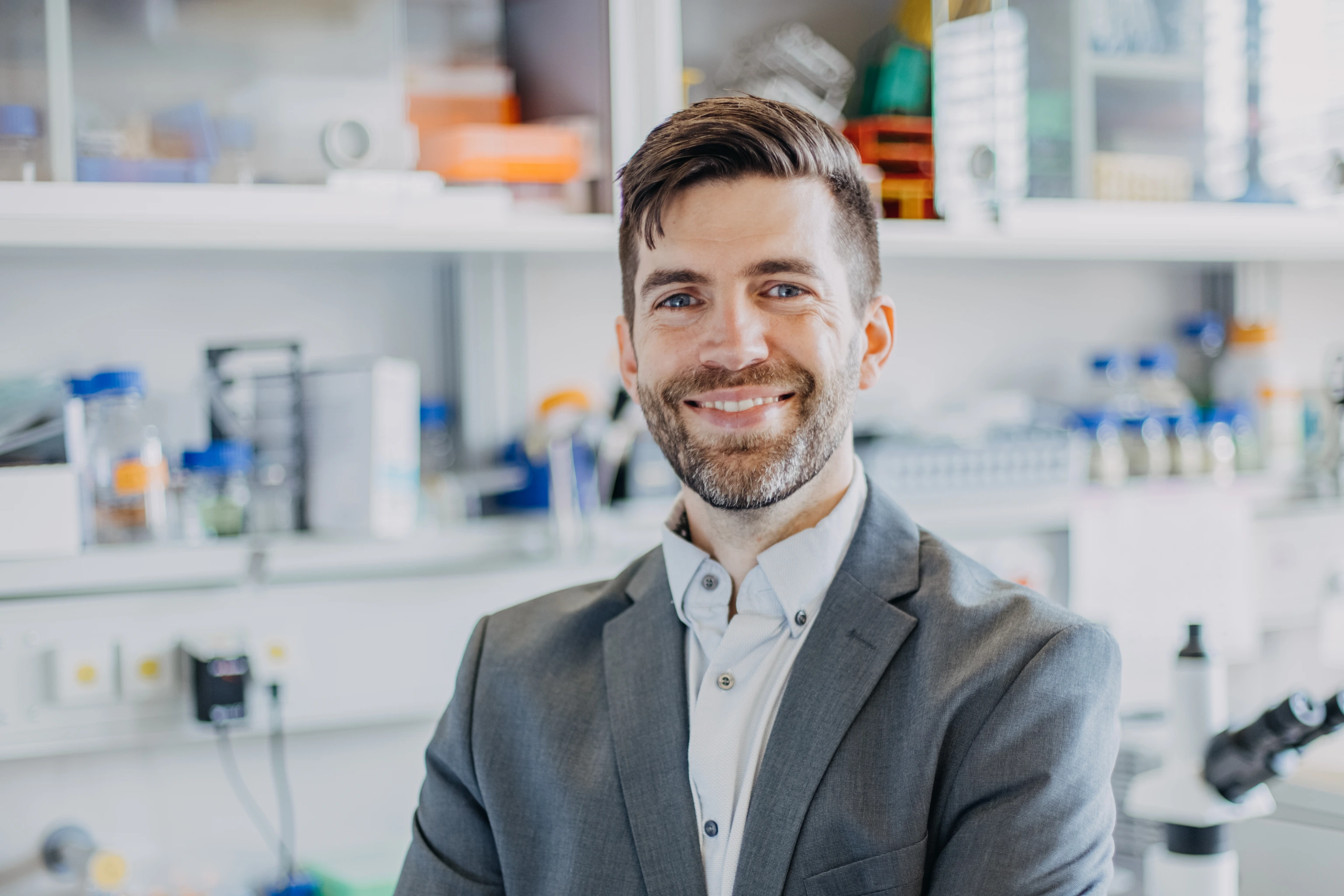
Group Leader, LHI
Prof. Dr. Markus Diefenbacher
“Like all cancer researchers, I want to tear off the cloak of invisibility from tumor cells. In doing this, I am enthusiastic about building bridges, about collaboration across scientific disciplines, methods or people!”
Visit the Diefenbacher Lab
Academic Career and Research Areas
Prof. Markus Diefenbacher brings a fascinating perspective to the study of the interaction between tumors and the immune system. He is fascinated by the genetic complexity of tumors, especially solid tumors. His research goals include deciphering the genetic complexity of tumors and developing innovative therapeutic approaches against lung cancer. Here it is, above all, the rapid development of new methods for imaging and analyzing complex biological processes that excites him.
Especially in the early days of his research at KIT, he was grateful for good mentors who encouraged his enthusiasm and ambition for science. His time abroad was also very formative, especially the work at Cancer Research UK (CRUK, now The Francis Crick Institute) in London and the exchange with world-leading scientists. In this period, he focused on two cancer entities, lung and colorectal cancer, and by using complex mouse genetics, significantly contributed to merging the fields of basic ubiquitin biology and cancer research. He then joined the Department of Biochemistry and Molecular Biology at the Biocenter of the University of Würzburg and started his first independent lab.
In 2023 he moved with his lab to Munich (Institute of Lung Health and Immunity, Helmholtz Munich) and focused on the development of novel murine models of solid tumours, especially lung- and intestinal cancer, by using virally encapsulated delivery of CRISPR components to epithelial cells, resulting in building the foundation of current internationally visible collaborations.
Fields of Work and Expertise
CRISPR surrogate models imaging spatial biology Oncology
multi-omics
Professional Background
Initiator and organizer of the annual “Building Bridges in Munich Cancer Research” Workshop
Investigator at Deutsches Konsortium für Translationale Krebsforschung (DKTK)
PI of the research group "Experimental Immuno-Oncology" at LHI/Helmholtz Munich and Professor of Experimental Pneumology at the LMU clinic Munich
Junior group leader in Würzburg at the Biocenter, Chair of Biochemistry and Molecular Biology
CRUK // Cancer Research UK Lincolns Inn Fields Research Institute (CRUK LRI), Holborn, London, UK
Diploma thesis with subsequent PhD at Helmholtz Zentrum Karlsruhe (now KIT Campus Nord), Institute of Toxicology and Genetics, in the group of Peter Herrlich & Olivier Kassel
Diploma Biology studies at the Karlsruhe Institute of Technology (KIT), Karlsruhe.
Interview with Prof. Markus Diefenbacher