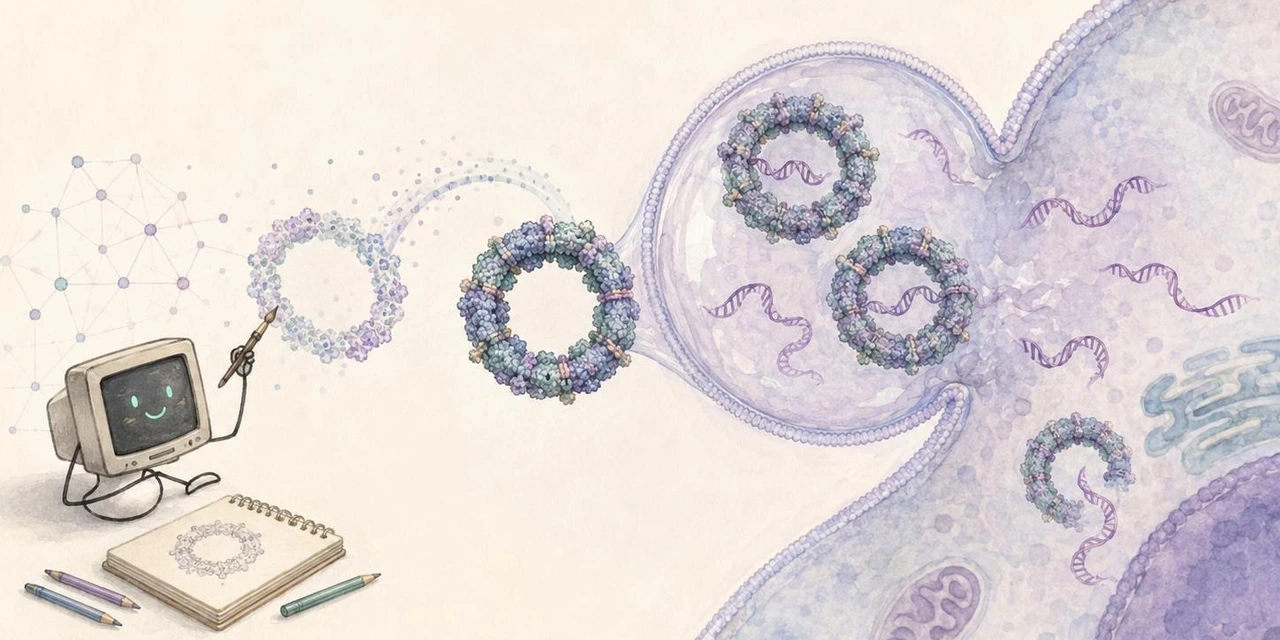
RNA-based therapeutics use RNA as a blueprint that enables cells to produce specific proteins – including proteins that can precisely modify genes. For this to work, the RNA must reach the inside of the cell intact. Delivery systems currently used for this purpose include virus-derived vehicles and lipid nanoparticles, tiny particles made of fat-like molecules. Both approaches have limitations. Researchers are therefore working on new mechanisms that can deliver RNA into cells more efficiently and, in the future, more selectively.
Research teams at the Institute of Stem Cell Research (ISF) and the Institute of Developmental Genetics (IDG) at Helmholtz Munich and TUM have now constructed an RNA transporter from the ground up. The researchers combined functional protein building blocks with a structural protein designed using generative AI. This protein forms the scaffold of the vehicle and can adopt shapes that do not occur in nature.
“We did not want to recreate nature, but to design new structures for a specific task: the efficient delivery of RNA,” says Dr. Christoph Gruber, team leader at the ISF and co-first author of the study.
The team tested more than one hundred variants. Surprisingly, protein structures with non-natural geometries performed particularly well. STV-C8 was the most efficient.
“The fact that a structure that differs so markedly from natural viral capsids works particularly well was a key finding for us,” says Dr. Maren Kirstin Schuhmacher, postdoctoral researcher at the ISF and also co-first author. “It demonstrates the potential of using AI to systematically expand the protein design space.”
In cell culture, STV-C8 delivered RNA into target cells far more efficiently than the virus-like particles and lipid nanoparticles tested. Compared with the lipid nanoparticles, its transfection rate was substantially higher; to achieve comparable protein production, STV-C8 required substantially less RNA. The system could also be loaded with different RNA cargoes and directed toward specific target cells.
“This modularity is particularly important to us because it allows us to adapt the transporter to different applications and target cells,” says Dr. Florian Giesert, group leader, Gene Editing, at the ISF.
The team tested whether the approach also works in a living organism using animal models. Following intravenous administration in mice, STV-C8 led to expression of the delivered RNA primarily in the lungs; the researchers found no evidence of immunological or toxic side effects. They also loaded STV-C8 with components of the CRISPR/Cas9 system and injected the transporter into the muscle of a pig. There, they succeeded in removing a disease-relevant section of the dystrophin gene. This gene contains the blueprint for a protein that stabilizes muscle cells and is disrupted in Duchenne muscular dystrophy.
STV-C8 is still an experimental system. Before it can be used medically, the researchers will need to investigate, among other things, how the vehicles can be directed specifically to particular cell types and how they distribute throughout the body.
“With STV-C8, we have created a platform that we can now further develop for a range of therapeutic applications,” says Prof. Wolfgang Wurst, Emeritus of Excellence at Helmholtz Munich and TUM and last author of the publication. The team also plans to transfer the technology into a spin-off company.
Original Publication
Schuhmacher et al., 2026: Creating bottom-up RNA transfer vehicles from synthetic protein assemblies. Nature. DOI: 10.1038/s41586-026-10952-3