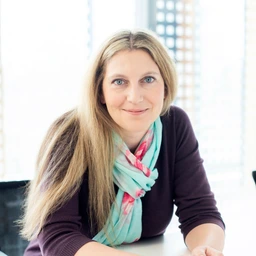
Appointment to the ERC’s Governing Body
The Scientific Council serves as the ERC’s independent governing body. It defines the organization's scientific strategy, oversees the implementation and performance of its funding programs, and ensures transparent communication with the scientific community and relevant stakeholders.
“It is an honor to join the ERC Scientific Council. I look forward to contributing to its mission of supporting frontier research and fostering scientific excellence across Europe,” said Prof. Eleftheria Zeggini.
“Helmholtz Munich is committed to scientific excellence and regards the ERC as a cornerstone of EU research funding. Eleftheria Zeggini’s appointment is a testament to her outstanding scientific achievements and leadership in science. This recognition by the ERC Scientific Council underscores the global impact of her work,” said Prof. Martin Hrabě de Angelis, Member and Spokesperson of the Executive Board (acting) at Helmholtz Munich.
A Leading Expert in Translational Genomics
Eleftheria Zeggini’s research focuses on translational genomics, with an emphasis on developing and applying statistical and computational methods to integrate molecular, genomic, and epidemiological datasets. She uses approaches such as large-scale GWAS to study complex diseases like type 2 diabetes and osteoarthritis, aiming to uncover shared mechanisms that drive their development and progression. Her goal is to translate these insights into better prevention strategies and more personalized treatment approaches.
About the ERC
Established by the European Union in 2007, the European Research Council supports outstanding researchers of any nationality through four core grant schemes – Starting, Consolidator, Advanced, and Synergy Grants – as well as the Proof of Concept program to facilitate early innovation. The ERC is guided by its independent Scientific Council, which defines its scientific strategy and ensures the quality of its funding processes.
About Prof. Eleftheria Zeggini
Eleftheria Zeggini is the Founding Director of the Institute of Translational Genomics at Helmholtz Munich and TUM Liesel Beckmann Distinguished Professor at the Technical University of Munich. She holds a BSc in biochemistry and a PhD in human genomics from the University of Manchester. Prior to joining Helmholtz Munich, she led a research programin analytical genomics at the Wellcome Sanger Institute in Cambridge, UK. Her professional distinctions include elections as Fellow of the Academy of Medical Sciences (UK), Fellow of ELLIS, Member of the Academia Europaea and EMBO, as well as service on the EMBL Council.