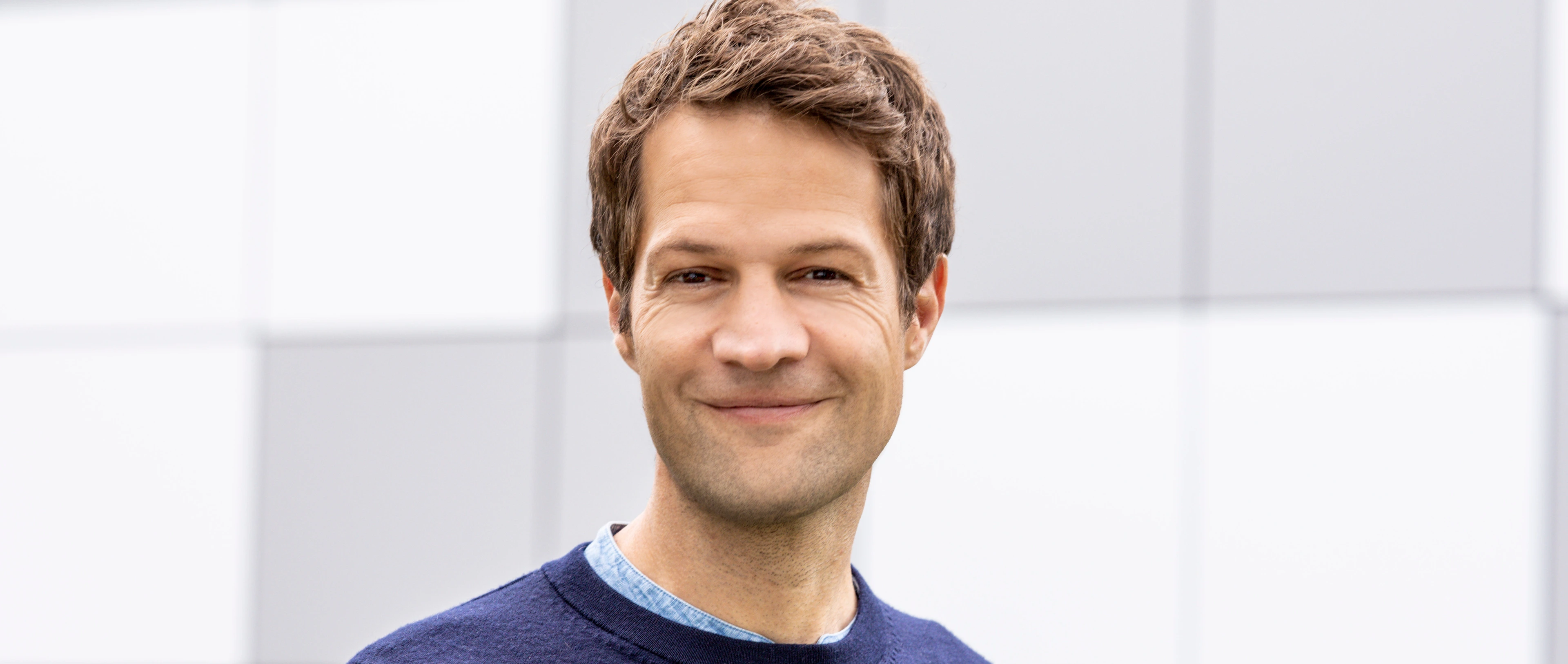
Head of the Computational Health Center, Director of the Institute of Computational Biology
Prof. Dr. Dr. Fabian Theis
"With AI, we can imagine a future where diagnosing and treating diseases is more affordable, widely available, and thus more democratic."
Academic career and research areas
Fabian Theis is a pioneer in biomedical artificial intelligence and machine learning. His research develops scalable statistical learning frameworks and biomedical foundation models for the integrative analysis of single-cell, spatial, imaging, and clinical data. A central focus is multimodal data integration across biological scales to enable predictive, data-driven precision medicine. His lab develops widely used computational methods and open-source software, including tools within the scanpy and scverse ecosystem.
Fabian holds Diplomas in Mathematics and Physics (with distinction), and two Doctorates in Physics and Computer Science.
Fabian’s career began as head of the research group “Signal Processing and Information Theory” at the Institute for Biophysics in Regensburg. As a Bernstein Fellow, he led a junior researcher group at the Bernstein Center for Computational Neuroscience at the Max Planck Institute for Dynamics and Self-Organization in Göttingen in 2006. One year later, he became head of a task force at the Institute for Bioinformatics at Helmholtz Munich. After two years, he was appointed Associate Professor (W2) for Mathematics in Systems Biology at the Technical University of Munich.
Fabian has held visiting positions at international institutes, including TUAT (Tokyo), RIKEN (Tokyo), and research stays in the USA and Finland.
Fabian is Head of the Computational Health Center at Helmholtz Munich and Director of the Institute of Computational Biology. He is also Chair for Mathematical Models of Biological Systems at the Technical University of Munich and Scientific Director of the Helmholtz Artificial Intelligence Cooperation Unit (Helmholtz.AI).
Selected networks and committees:
- Member, Board of Directors, Human Cell Atlas
- Member, Steering Board, Munich School for Data Science (MUDS)
- Member, Steering Board, Gauss Centre for Supercomputing
Focus areas, skills, expertise
Biomedical Artificial Intelligence Foundation Models in Biomedicine
Single-Cell and Spatial Omics
Multimodal Data Integration
Statistical Machine Learning
Stochastic and Dynamical Systems Modeling
Open-source scientific software (scanpy, scverse)

Facts and Figures
Member, German National Academy of Sciences Leopoldina
...for representing German science abroad and advising lawmakers ans public
Chair of the Bavarian AI Council of the Bavarian Government
2024 - Interim Chair
2020 - Co-chair
Member of the Board of Directors of the Human Cell Atlas
Head of the Computational Health Center, Helmholtz Munich
Scientific Director, Helmholtz Artificial Intelligence Cooperation Unit, Helmholtz.AI
Director, Institute of Computational Biology, Helmholtz Munich
Chair for Mathematical Models of Biological Systems, Technical University of Munich
ERC Advanced Grant 'DeepCell'
aim: predict how cells react to drugs using machine learning
Hamburg Science Award
for his work on artificial intelligence and analysis processes for large data sets and resolving biomedical questions
Erwin Schrödinger Award from the Stiftungsverband and the Helmholtz Association
for outstanding interdisciplinary research
Head of junior research group "Computational Modeling in Biology"
Heinz Maier-Leibnitz Award of the German Research Foundation


Big data in medicine
Schwanke meets Science


Key publications
Key publications
Sikkema, L., Ramírez-Suástegui, C., Strobl, D. C., Gillett, T. E., Zappia, L., Madissoon, E., Markov, N. S., Zaragosi, L.-E., Ji, Y., Ansari, M., Arguel, M.-J., Apperloo, L., Banchero, M., Bécavin, C., Berg, M., Chichelnitskiy, E., Chung, M.-I., Collin, A., Gay, A. C. A.,Theis, F. J. 2023. An integrated cell atlas of the lung in health and disease. Nature Medicine, 29(6), 1563–1577. Nature Medicine.
Fischer, D.S., Schaar, A.C. & Theis, F.J. 2022. Modeling intercellular communication in tissues using spatial graphs of cells. Nature Biotechnology.
Palla, G., Spitzer, H., Klein, M., Fischer, D., Schaar, A.C., Kuemmerle, L.B., Rybakov, S., Ibarra, I.L., Holmberg, O., Virshup, I., Lotfollahi, M., Richter, S., Theis, F.J.2022. Squidpy: A Scalable Framework for Spatial Single Cell Analysis. Nature Methods.
Lange, M., Bergen, V., Klein, M., Setty, M., Reuter, B., Bakhti, M, Lickert, H. Ansari, M. Schniering, J. Schuller, H.B., Peér D., Theis F.J. 2022. CellRank for directed single-cell fate mapping. Nature Methods.
Luecken, M.D, Büttner, M. Chaichoompu, K., Danese, A., Interlandi, M., Mueller, M. F., Strobl, D. C., Zappia, L., Dugas, M., Colomé-Tatché, M., Theis, F.J. 2022. Benchmarking atlas-level data integration in single-cell genomics. Nature Methods.
-
For the complete list of publications, see Google Scholar