Capturing Life in Motion
The symposium highlighted how adding time as a fourth dimension to traditional structural biology provides unprecedented insights into the internal motions of biomolecules. Understanding these dynamics – described as “biomolecular breathing” – is key to uncovering the principles that govern biological function and to developing new therapeutic strategies.
Exploring the 4D Perspective
Discussions focused on how ultra-highfield NMR, a technique that reveals molecular structures at atomic detail, can be combined with complementary methods such as cryo-electron microscopy (cryo-EM), Förster resonance energy transfer (FRET), advanced computational modeling, and AI-based methods.
The interdisciplinary combination of these approaches allows scientists to visualize molecules in motion, showing how subtle structural changes over time influence the protein function and intramolecular communication pathways. This enables regulation of biomolecular functions and provides unique opportunities for drug discovery by exploring allosteric sites that help to overcome resistance.
Global Expertise on Stage
The symposium was opened by Michael Sattler, internationally recognized for advancing structural biology using ultra-highfield NMR to uncover RNA and protein mechanisms relevant to drug development. Together with co-organizers Reid Alderson, Steffen Glaser, Franz Hagn, Bernd Reif, and Anne Schütz, he led six sessions featuring 20 distinguished speakers from leading institutions worldwide:
Fred Allain (ETH Zurich), Hari Arthanari (Harvard Medical School), Lucia Banci (CERM Florence), Martin Blackledge (IBS Grenoble), Giovanni Bussi (SISSATrieste), Teresa Carlomagno (University Birmingham), Juli Feigon (UCLA), Steve Fesik (Vanderbilt University), Kevin Gardner (CUNY), Christian Griesinger (MPI Göttingen), Angela Gronenborn (University Pittsburgh), Stephan Grzesiek (Biozentrum Basel), Janosch Hennig (University Bayreuth), Sebastian Hiller (Biozentrum Basel), Nadia Izadi-Pruneyre (Institute Pasteur), Marion Jasnin (Helmholtz Munich), Alisha Jones (NYU), Don Lamb (LMU), Tobias Madl (Mediuni Graz), Hartmut Oschkinat (FMP Berlin), Art Palmer (Columbia University), Rina Rosenzweig (Weizmann), Harald Schwalbe (University Frankfurt), Rebecca Wade (University Heidelberg), Gerhard Wagner (Harvard Medical School).
Networking and Collaboration
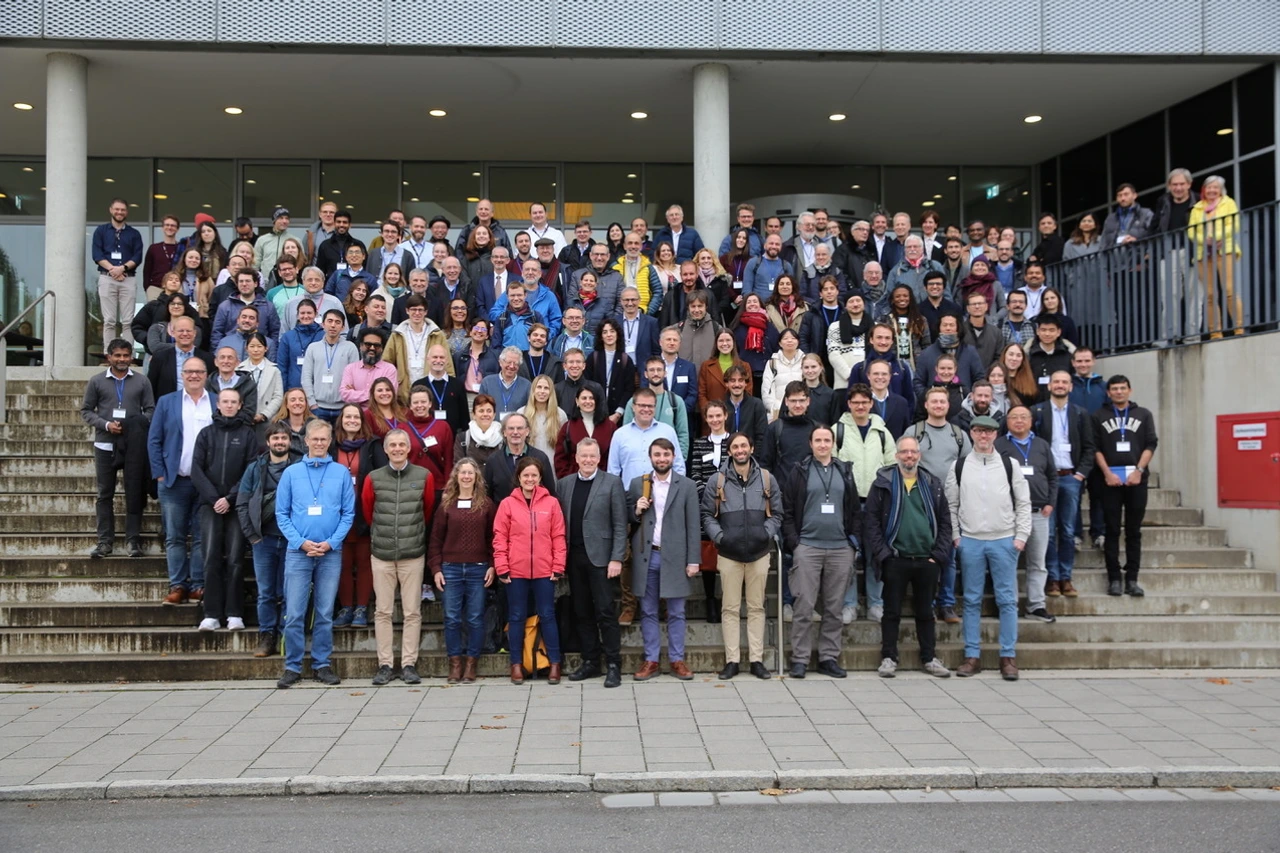
Beyond the lectures, the symposium fostered informal exchange with over 150 participants. During the dinner keynote, Giles Yeo (University of Cambridge) addressed the future of obesity treatment in the post-Ozempic era, sparking lively discussions across disciplines.
More information on theBNMRZ Symposium.