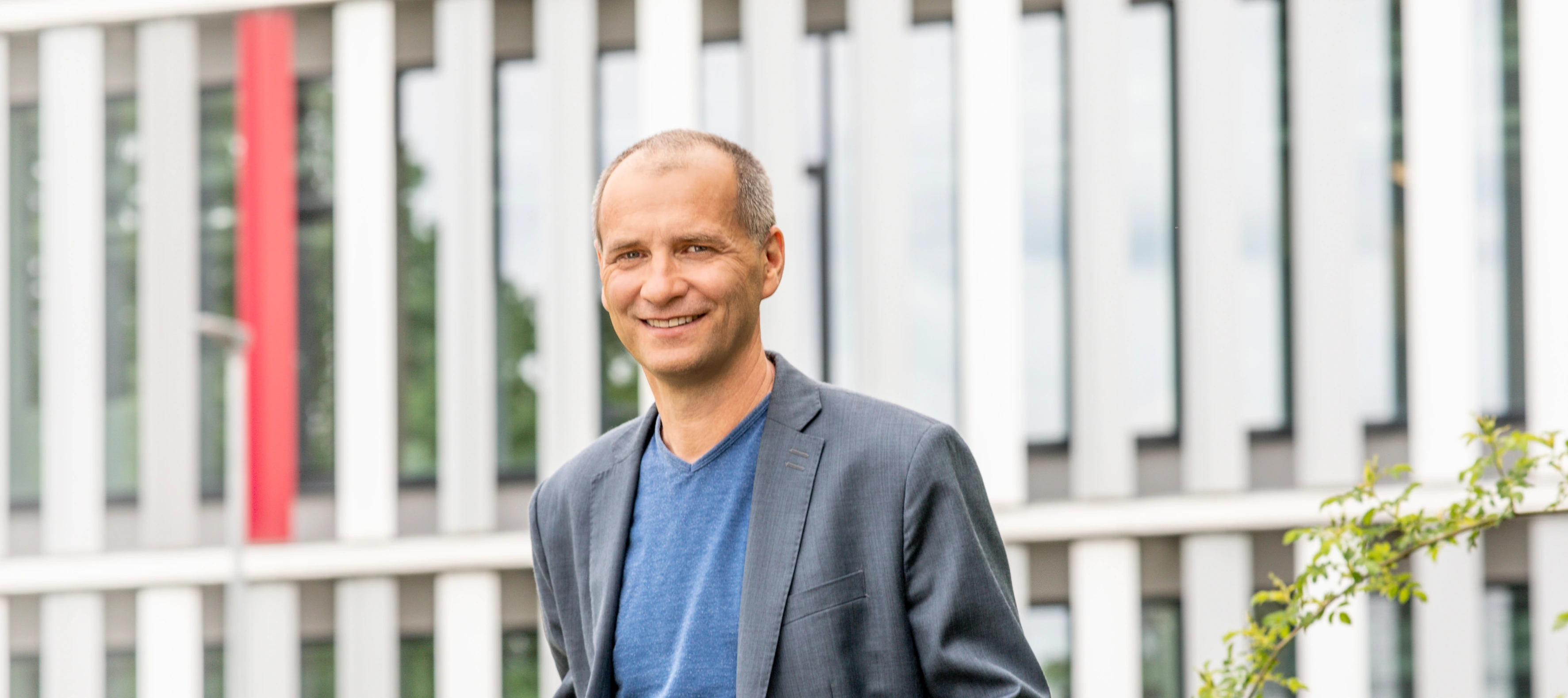
Daniel Krappmann

Head of Research Unit Signaling and Translation

Prof. Dr. Daniel Krappmann

“My research is dedicated to decipher molecular machineries controlling immune activation and to translate this findings into the development of new therapies to fight immune diseases and cancer.”

Academic Pathway and Research Area

He started his academic career as a PhD student and continued his studies on signal transduction in cancer cells as a postdoctoral fellow and junior group leader at the Max-Delbrück-Center (MDC) for Molecular Medicine in Berlin. His Research Unit at Helmholtz Munich is dedicated to study physiological and pathological signaling pathways in the immune system and in cancer.

The identification of the pro-proliferative and anti-apoptotic function of signaling networks in human tumor cells inspired his long-standing efforts to bridge the gap between basic science and clinical translation. He has been leading a successful drug discovery program and the pre-clinical development of new immune modulatory drugs. Candidate drugs from this program are currently tested in the clinic for their ability to boost our immune defence to fight cancer.

Skills and Expertise

Immunology Oncology Cancer 

Cell Signaling   T cell Biology  Target Identification  Drug Discovery

Professional Career

since 2023

Director of Research Unit Signaling and Translation

since 2013

Head of Research Unit ‘Cellular Signal Integration’

since 2012

Adjunct Professor Faculty of Biology, Ludwig-Maximilians-Universität München

2005 - 2012

Group Leader Helmholtz Munich

2002 - 2005

Head Junior Research Group at MDC Berlin

1997 - 2002

Postdoctoral Fellow at Max-Delbrück-Center (MDC) Berlin

Honors and Awards

  • Delbrück Fellowship Award (MDC Berlin) 2002

Publication Highlights

Jones, A.N., C. Grass, I. Meininger, A. Geerlof, M. Klostermann, K. Zarnack, D. Krappmann, and M. Sattler

Modulation of pre-mRNA structure by hnRNP proteins regulates alternative splicing of MALT1.

O'Neill, T.J., T. Seeholzer, A. Gewies, T. Gehring, F. Giesert, I. Hamp, C. Grass, H. Schmidt, K. Kriegsmann, M.J. Tofaute, K. Demski, T. Poth, M. Rosenbaum, T. Schnalzger, J. Ruland, M. Gottlicher, M. Kriegsmann, R. Naumann, V. Heissmeyer, O. Plettenburg, W. Wurst, and D. Krappmann

TRAF6 prevents fatal inflammation by homeostatic suppression of MALT1 protease.

Kutukculer, N., T. Seeholzer, T.J. O'Neill, C. Grass, A. Aykut, N.E. Karaca, A. Durmaz, O. Cogulu, G. Aksu, T. Gehring, A. Gewies, and D. Krappmann

Human immune disorder associated with homozygous hypomorphic mutation affecting MALT1B splice variant.

Stangl, A., P.R. Elliott, A. Pinto-Fernandez, S. Bonham, L. Harrison, A. Schaub, K. Kutzner, K. Keusekotten, P.T. Pfluger, F. El Oualid, B.M. Kessler, D. Komander, and D. Krappmann

Regulation of the endosomal SNX27-retromer by OTULIN.

Meininger, I., R.A. Griesbach, D. Hu, T. Gehring, T. Seeholzer, A. Bertossi, J. Kranich, A. Oeckinghaus, A.C. Eitelhuber, U. Greczmiel, A. Gewies, M. Schmidt-Supprian, J. Ruland, T. Brocker, V. Heissmeyer, F. Heyd, and D. Krappmann

Alternative splicing of MALT1 controls signalling and activation of CD4(+) T cells.

Nagel, D., S. Spranger, M. Vincendeau, M. Grau, S. Raffegerst, B. Kloo, D. Hlahla, M. Neuenschwander, J. Peter von Kries, K. Hadian, B. Dorken, P. Lenz, G. Lenz, D.J. Schendel, and D. Krappmann

Pharmacologic inhibition of MALT1 protease by phenothiazines as a therapeutic approach for the treatment of aggressive ABC-DLBCL.

Networks, Partners and Affiliations

Logo LMU - Ludwig-Maximilians-Universität München

LMU – Faculty of Biology

Read more
DFG logo blau PNG

DFG

Read more
SFB1335 - Aberrant Immune Signals in Cancer

SFB1335 - Aberrant Immune Signals in Cancer

Read more
SFB 1054 Cell-Fate Decisions

SFB 1054 – Control and Plasticity of Cell-Fate Decisions in the Immune System

Read more